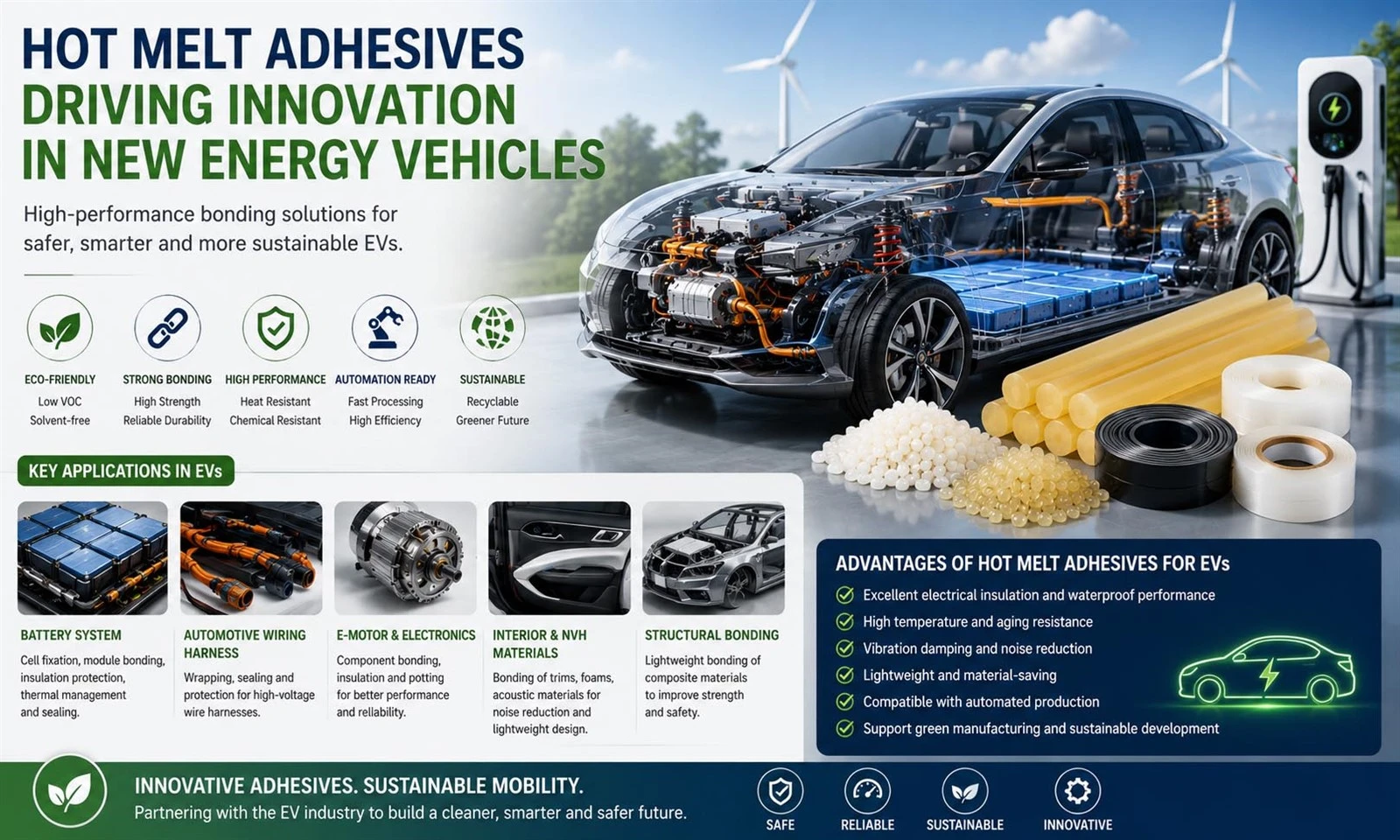
As the global new energy vehicle (NEV) industry enters a phase of rapid expansion, automotive manufacturing technologies are continuously evolving toward lightweighting, intelligent systems, and enhanced safety. As a vital auxiliary material in vehicle manufacturing, hot-melt adhesives are playing an increasingly important role in the NEV sector, thanks to advantages such as rapid bonding, solvent-free eco-friendliness, high durability, and suitability for automated production. From power batteries and motor systems to wiring harnesses, interior components, and vehicle body structures, hot-melt adhesives are becoming a key material driving innovation in NEV manufacturing processes.
Compared to traditional internal combustion engine vehicles, NEVs impose stricter requirements regarding the safety and reliability of components. As the core component of an NEV, the power battery must withstand long-term exposure to vibration, extreme temperatures, and complex environmental conditions, necessitating rigorous standards for sealing, protective, and securing materials. With their excellent bonding and sealing capabilities, hot-melt adhesives are used in applications such as battery pack protection, module securing, electrical insulation, and component bonding, effectively enhancing the stability and service life of the battery system.
In power battery manufacturing, functional hot-melt adhesives are utilized in processes such as cell securing, thermal insulation material bonding, and protective film lamination. Unlike traditional adhesives, hot-melt adhesives require no solvent evaporation and offer rapid curing, meeting the demands of high-speed automated assembly in NEV production. Furthermore, certain high-performance hot-melt adhesives exhibit excellent temperature resistance, electrical insulation, and aging resistance; they can withstand the complex operating environments of power batteries, thereby ensuring the safe operation of NEVs.
Beyond power batteries, automotive wiring harnesses represent another significant application area for hot-melt adhesives. NEVs incorporate far more electrical equipment than traditional vehicles-featuring a substantial increase in high-voltage harnesses, sensor wiring, and control system circuits-which raises the bar for protection, waterproofing, dustproofing, and abrasion resistance. Through encapsulation, securing, and sealing, hot-melt adhesives enhance the mechanical strength and environmental resilience of wiring harness systems, reducing safety risks associated with long-term vibration and friction. Amid the industry-wide trend toward vehicle lightweighting, hot-melt adhesives are also increasingly replacing traditional mechanical fastening methods, finding widespread use in automotive interiors, door assemblies, sound insulation materials, and the bonding of composite materials. Thanks to their lightweight nature and high application efficiency, hot-melt adhesives help automotive manufacturers reduce component weight and boost production efficiency, while simultaneously meeting the demand for extended driving ranges in new energy vehicles (NEVs).
In recent years, as the NEV industry chain has matured, hot-melt adhesive technology has undergone continuous upgrades. Industry R&D has shifted focus from basic bonding capabilities toward high heat resistance, high strength, eco-friendliness, and multifunctionality. High-performance products-such as polyamide (PA), polyolefin (PO), and reactive polyurethane (PUR) hot-melt adhesives-are meeting the rigorous application standards of NEV manufacturing, thanks to their superior heat, chemical, and weather resistance.
Looking ahead, the continued growth of NEV sales, alongside advancements in smart vehicle and autonomous driving technologies, will lead to an increase in automotive electronic components and a rising demand for high-performance adhesive materials. Hot-melt adhesive manufacturers must continuously enhance their material R&D capabilities and strengthen collaborations with automakers, battery manufacturers, and component suppliers to provide safer, more efficient, and environmentally friendly bonding solutions for the NEV industry.
The development of NEVs has not only driven transformation within the automotive industry but has also created new growth opportunities for the hot-melt adhesive sector. As a vital material for bonding and protection, hot-melt adhesives will play an increasingly critical role in future NEV manufacturing, supporting the automotive industry's ongoing evolution toward greener and smarter operations.